Pages

Translate

Thursday, January 2, 2020

30 Day D&D Challenge - How I Got Started - Day One

Today's topic is How I got started playing Dungeons & Dragons, now called Original D&D in my case.

A little background, I grew up in a rural area on a farm in southern Ohio where my family had moved from central WV. We at one time or another had sheep, cows, hogs, chickens, guineas, horses, goats, turkeys, cats, dogs and a pony or two and a mule. We spent a lot of time outdoors and in the woods. Farm work was inter spaced with hunting and fishing. However, a big part of our lives as kids was my dads stories, he had hundreds of them, as did our grandfathers and uncles. We were also read to every night and we also heard fairy tales and other stories. When I started reading I was introduced to the library where I devoured all the fairy tales, folk stories, mythology, fantasy and science fiction I could get my hands on. 

I discovered Edgar Rice Burroughs and Robert E Howard,  One Thousand and One Nights, Beowulf, King Arthur and the Knights of the Round Table, Robin Hood, Jonathan Swift, Mary Shelley, Edward Bulwer-Lytton, Jules Verne, H.G. Wells, Samuel Butler, Sir Arthur Conan Doyle, Rudyard Kipling, Nathaniel Hawthorne, Edgar Allan Poe, Mark Twain, L. Frank Baum, Jack London, George MacDonald, Peter S. Beagle, G. K. Chesterton, Lord Dunsany, E. R. Eddison, E. T. A. Hoffmann, Willaim Morris, Clark Ashton Smith, Frank R. Stockton, and of course J. R. R. Tolkien and too many others to count. This does not even get into the movies that I saw. The earliest I remember is seeing The Blob the summer before first grade. I loved the Sword & Sandal movies, the Pirate movies, the old horror movies that were shown on TV, Science Fiction and Westerns and a ton of others.

Fast forward to the fall of 1975. The first day or two of the fall semester I met a guy from Columbus who had gotten Dungeons & Dragons in the spring of 1974 and had played with his friends always as the referee. He told me about the game and I was immediately all in. In a few days, we had our first game with 12 players, 6 men and 6 women. Fields of study (majors) ranged from English, French, Latin, to Biology, History, Chemistry, Geology, Physics and Engineering. At least those are the ones I remember.

Our first game  two elves, two dwarves, one hobbit and seven humans. That was pretty much the ratio even when the group got bigger. In the beginning both dwarves and the hobbit were fighters, but later on there would be two hobbits thieves, one dwarven and one elven thief. In the beginning both elves were magic users, we only had one guy who ever played an elven fighter/magic user. Of the seven humans we had two magic-users, one cleric and four fighters. So the initial 12 were one cleric, four magic users and seven fighters. We only had one guy who ever played a cleric, and he is now one in real life for lo these many years, well a priest that is. 

I have vivid memories of the first game and going through six characters that first evening. :D When death is not permanent because you can roll up another character and be back in the game in a few minutes, how cool is that! I was the stand in the gap guy which is what I enjoyed doing. I eventually got a few characters up to 8th or 9th level. We played twice a week from 8-12 hours per game and occasionally much longer. We had one finals week where many of us were done by Tuesday and we played most of the day (16 hours or so) for three days straight.

The referee had a set of table dice that we all used to roll up on characters 3d6 in order no adjustments or re-rolls. Hit Points were 1d6 and if it was a one, well that is what you had. From the first game we ran all action as being simultaneous. A natural 20 always hit and on a natural 20 you rolled again and a second natural 20 was a kill. I varied that in a number of different ways over the years.

Within a few games we started adding players and later than year we usually had 16 players. Also within a few games, we had people hanging out and watching the games. In the later years, we ran 16-20 players every game, mid 20's maybe a dozen times, and high 20's up to 30 a couple of times. We always had an audience and I would guess at least 60-70 different people played at least once. Every game had a different cast with a core group that was always there and the rest varied from game to game.

When we had a party of 20 later on, we would have one cleric, four thieves, six magic-users and nine fighters. So we were always light on healing magic, and magic items for the cleric were a priority and he always got first dibs on the magic armor. Yeah, we wanted to keep him alive. One guy alternated between magic-users and thieves and never once played a human, except for later on when he played druids. The guy who played the elven fighter/magic-user (the other ref) also played human fighters, an Illusionist and a Bard. I was the only one who ever played a paladin or a ranger.

Out of that whole group I was the only one that got to read the rule books (and to be sure the only one that ever asked) and the only one that my friend ever offered to let ref. A month, maybe two, in I started reffing and he moved over to playing and I did most of the reffing after that as he would much rather play and had not gotten to up to that point. Once I had access to the books, I ordered my own set. No one else was ever interested in being a referee, and he preferred to play, I was the one that preferred to ref, of which I was quite happy.

The guy that introduced us to D&D never ran a dungeon, it was all city and wilderness, but after I had reffed for a little while I decided to do a dungeon. My prep for the game was selecting nine quotes. When the game started they set out across a desert for two weeks until they came to an old set of ruins (yeah, I liked Ruins from the beginning) and eventually down into the dungeon below. Somewhere in a box I might still have that list of quotes. My first dungeon ran horizontally and after travelling for a ways through a rock walled cavern they came to a large oak door that looked very old and was covered with cobwebs. Beside it on the rock wall was the first quote carved into the wall. They got the door open and the adventure began. 

They eventually made it through each area, (some of which involved game weeks) and continued to the next door. I do not remember a ton about it without being able to look at the quotes, but I do remember that it was a very psychological adventure, one area being one where they had to figure out that they were being lulled to complacency from which they would never leave, one of them figured it out and then had to convince the rest of the group to continue which he almost failed to do. At the end of it they had obtained no treasure and fought no physical battles, but they talked about it all week and I got a lot of good feedback on the game.

I have always run all of my games the same way, very minimal prep and create on the fly from very minimal prompts. I do write things up and tinker with the rules all the time, but I never pre-plan an adventure. I create opportunities and then let things unfold and surprise us all. When I sat down with those quotes, behind each door I was as surprised as the players were. I can run a game on zero notice anytime and anywhere, I am always ready to run a game and create a complete new world on the fly. I enjoy creating one of a kind magic items, all types of quirky things, and one of a kind monsters. My inspirations are people like Dave Arneson and Dave Hargrave. My games are fast and furious with a lot of what is called "player agency." I loved the question, "What do you want to do?" That is the most important part of OD&D, is being willing to keep asking that question.

IMO and For Me, improvisational gaming is the maximum fun and the players kept coming back twice a week for the four years of college gaming. It still works even today with all ages. I also played it with my younger brothers during the summers.


If you made it this far the topic for tomorrow is 30 Day D&D Challenge - Favorite Playable Race.

Wednesday, January 1, 2020

2020 - The Year of Blackmoor - 50th Anniversary

Today begins a year of celebration of Dave Arneson's Blackmoor as we kick off 2020 - The Year of Blackmoor - 50th Anniversary. I will be posting now and then throughout the year talking about Blackmoor and Dave Arneson. If you saw my heads up post a few days ago, then you already know what this is about. If you did not I will wait while you check it out here

You are back, great so you have read the disclaimer and we are on the same page and you know where I am coming from.

Dave Arneson played a multitude of games including wargames and one of his friends David Wesely decided to do an experiment and created  a scenario set in the fictional German town of Braunstein. Mr. Wesely (due to the chaos and the way his scenario was turned upside down) considered it a failure and was greatly surprised when his players kept asking when he would do it again. While I will talk about this more in the future, the short story is that he did run more of them and one player - Dave Arneson - in one particular scenario about a fictional Central American country pushed the experiment way further than Mr. Wesely was initially prepared to go, but he decided to say "Yes" to what Arneson proposed to do in a pre-game meeting and that as they say "has made all the difference."

Dave Arneson always credited David Wesely as the creator of the roleplaying game, but I would point out that it really appears to me that it was the synergy between Dave Arneson and David Wesely that created roleplaying games. IMO Dave Arneson gave credit because without that "Yes" who knows when or how or by whom roleplaying games would have been created. The imaginative scenarios were named Braunstein after the town in the first one and they provided the soil. The additional imagination and wanting to run with the possibilities came from Dave Arneson, this was the water. The "Yes" from David Wesely was the sunshine, that made it all grow. All the other players were important, I do not mean to slight them at all, so please do not misunderstand.

When David Wesely left Minnesota in 1970 for military duty, Dave Arneson took over running the Braunstein games and this was the beginning and genesis of Blackmoor. That is why the 50th anniversary is this year 2020.

January is International Original Dungeons & Dragons Month (30 day Challenge starts tomorrow on the 2nd)

Today January 1st is the beginning of International Original Dungeons & Dragons Month. Today's post will be brief; however, this month I will be attempting to post everyday and do a 30 Day D&D Challenge. Each day I will  give you the topic for the following day. It will run Jan 2nd through Jan 31st.

The Topic for tomorrow Jan 2nd. will be "How You Got Started." If you participate please include use the title "30 Day D&D Challenge - How I Got Started" as part of your title.

This month and the posting in the challenge will be to celebrate the 46th anniversary of the publication of the Original Dungeons and Dragons in January of 1974.

There may be some other posting going on besides the challenge on some days during this period. I hope that you enjoy this and that sometime this year you will try the Original Dungeons and Dragons if you have never done so before or if it has been a long time since you have played it.

Monday, December 30, 2019

Coming Soon! - 2020 - The Year of Blackmoor - 50th Anniversary

In about 29 hours from when I am writing this the year of 2020 begins. Some are calling this the year of the Double Critical! Some say that given local, national and international circumstances that this being the year of the Double Critical is no coincidence! Well, I will leave that up to the reader to decide. There is something about 2020 that is oddly appropriate; however, 2020 is the 50th Anniversary of Blackmoor, the creation of David "Dave" L. Arneson. 

Disclaimer: I am not an historian and since there is no agreement on exactly when Blackmoor started and there are many possible points when the glimmer of Blackmoor first appeared, here is what I am going with. Some believe that it started in late 1970 (or possibly earlier) and then there is the "poker game under the troll bridge" on April 17, 1971. So for the purpose of celebrating Blackmoor and Dave Arneson I am going with late 1970 as the unofficial (yet true) beginnings and April 17, 1971 official documented beginning and will; therefore, begin the celebration of the 50th Anniversary in the year 2020 AD. Besides I like the symmetry of 2020 and many of us (well, me) are not getting any younger so why wait. Some (many??) may object, I say join the party, celebrate and have a good time, this is close enough, do not be a rules lawyer, pick up those dice and make your roll!

So this year we will have the following celebrations around Blackmoor and Dave Arneson:

2020 - The Year of Blackmoor - 50th Anniversary

April 17 - Blackmoor Campaign Day

September 24 to September 30 Blackmoor Week

October 1st Dave Arneson Game Day

We will also celebrate these additional holidays throughout the year:

January is International Original Dungeons & Dragons Month

January 26th is International Original Dungeons & Dragons Day

March 15th is OD&D Inspirational Author Day

May 18th to May 24th is Arduin Week

May 25th is Dave Hargrave Day

July 27th is Gary Gygax Day

If there are any that I have missed I will catch up with it later on. Oh BTW, coming up in 2024 The Year of Original Dungeons & Dragons - 50th Anniversary!

Thursday, December 19, 2019

Old School Game Play - One Point of Many

Over at my forum The Ruins of Murkhill on proboards, my Admin (El Borak) started a thread titled The Gaming Philosophy of The Perilous Dreamer - a thread that I need to do some posting in when I have time, hopefully soon. *But more on that later.

The interesting thing for me was the link to a thread/post over at theRPGsite titled The 2019 annual Christmas Game - D&D is not a shared storytelling game!

Here is the post that was made at The Ruins by the Admin. He said:
 I was surprised to see this over at theRPGsite The 2019 annual Christmas Game - D&D is not a shared storytelling game!.
thedungeondelver wrote:
[Quote] The stories of D&D are not character backgrounds or elaborate plots created by the DM. They're the memories we create when we play, whether meta-game or within the game, they're the "Remember the time Bob cast invisibility on himself, and tied the Giant's shoelaces together as the giant slept?" moments. 
Snip 
It's memories like that, which are the "story" of D&D games.[/Quote]
This sounds just like what you have been preaching for years.
So a few points, one is that agreement with my long standing stance on "story" and from this particular source was quite unexpected. I have always said that "story" in D&D and specifically in OD&D does not exist prior to the start of game play and further it is not something that the Referee introduces to the players at the table. "Story" is the shared memories created through play at the game table as the players interact with the Referees campaign world. 

A pre-existing "story" would be a novel or a script and such a thing would by its very presence constitute at the very least some railroading and most likely a lot of railroading. Such preexisting "story" would also limit the actions and decisions of the players and it has been my observation that it also creates parts of the game world (and NPCs) which cannot be touched. 

The original design of D&D and particularly OD&D is an open-ended sandbox. A sandbox is filled with content, but no limits are placed on the players, they can go off the prepared map and new content is created on the fly, improvisation is a Referee's friend and primary toolkit. Also, importantly, in a sandbox the PCs can "wreck the world". This is crucial to the concept of "player agency."

The whole concept of "wrecking the world" is a used as a pejorative by the railroaders against the standard paradigm of an OD&D sandbox game world, but in a sandbox there is no such thing as "wrecking the world", it does not exist as a concept for the simple reason that the world was created for the players to explore and since there is no script to follow the players can do anything they want within what is physically and magically possible for that specific game world.

The second thing I noticed about the thread at theRPGsite is that over 36 hours after it was posted no one else has posted in the thread. It is being studiously ignored. Meanwhile the threads both before and after it are quite active.

The third thing of course is I do not find this surprising given the emphasis placed on "story" these days. 

*I said I would get back to the subject of posting in the thread on the forum later. On Twitter I found two different posts with a list of questions, one of which is in the form of a 30 day challenge. It is my intention to begin soon, maybe even next week on the first and then start the 30 day challenge on on New Years Day on the second. I plan to talk about them in the thread and also post about them here on the blog. So that will be a long series of posts that should run about 45 days once I get started on it.

Wednesday, December 11, 2019

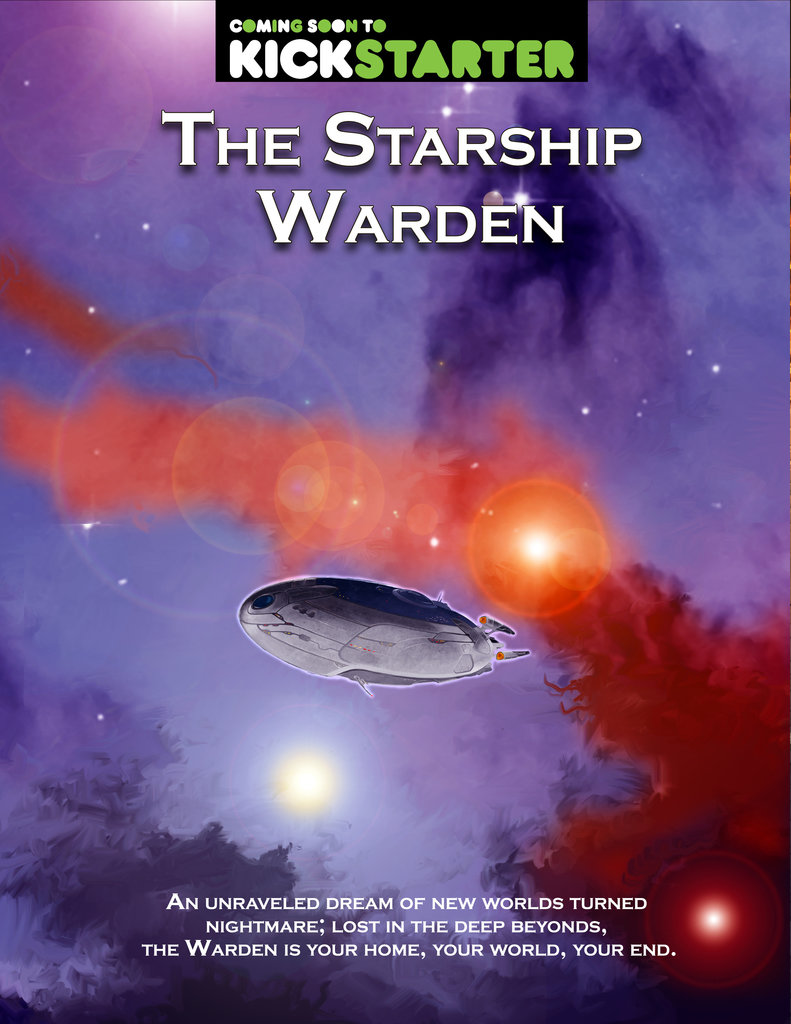
Starship Warden Kickstarter is now live!!

The Kickstarter is now live!!
An unraveled dream of new worlds turned nightmare; lost in the deep beyonds, the Warden is your home, your world, your end.


Story

Run Down #1: The Starship Warden is lost to us! It's up to you to find it! Dock your ship here and plunge in, the madness has begun! Join the fray today and receive a DIGITAL copy of James M. Ward's Magical Complexities, magic items created by James M. Ward at the table of Gary Gygax and in the company of so many founders of the hobby we love so much...

Near the beginning of the 24th century, humans began the largest construction ever undertaken by their species. Larger than most cities, the project was forty-nine miles long, twenty-four miles wide, and more than six miles in height. The manufacture of this colossus required decades of labor by thousands of skilled craftsmen. It was a feat unequaled in human history at that time. Too large to be manipulated in planetary atmosphere and gravity, this behemoth was built in orbit. It was developed to provide safety for more than a million souls and was to be filled with myriad forms of life.

Packed with the latest technology available at the time, the starship was capable of 90% of the speed of light. A trip to Alpha Centauri was but a mere 6 years. A host of other systems were well within reach, and this vessel was to take humanity to the stars. The planning for this mission was meticulous, the courage of her crew unquestionable, and the hopes of mankind ever present. She was named the Warden after her designer, and she set off for the stars in the late 24th century.

Less than two decades into her mission, she simply disappeared. There has now been no word of the Warden for more than 300 years....


The Starship Warden is a sandbox adventure setting written by James M. Ward and Christopher Clark. It is intended for use with the StarSiege RPG, a Siege Engine game, (Free with this Kickstarter). But, if you are loyal to the old MA, don't despair, the Starship Warden is written to allow you to use your original Metamorphis Alpha Rules and begin a lifetime worth of play. The Starship Warden is a 650+ page black and white, hard cover book that will retail for $74.99, the digital version of the book will retail at $20.00. An interstellar starship, set adrift, with 17 monstrous decks to explore, hordes of creatures and mutants, treasures both fantastic and scientific, it is a world within a ship. A setting like no other.

All 17 Fully detailed Decks with all environmental conditions
The dome, or 18th level
16 Levels set between the decks
Legacy Humans the descendants of the original crew
Cryogenically frozen humans
Mutated Plants and animals
Surviving but evolved species
Robots, Androids and new tech
A host of maps (18 deck and dome maps, 16 crawlway maps and scores of smaller maps
Monsters and mutants
Weapons and equipment
The Crawl-ways

The Starship Warden is a project long in the works. Originally the Starship appeared in James M. Ward's Metamorphis Alpha RPG, published in the bygone days of the 1970s. It has seen many iterations since then. Appearing in countless books and pubs, however, it has never been presented fully fleshed out and as its creator, James Ward, envisioned it.

Now, for the first time, decades after its creation, The Starship Warden comes to life in all its 17 levels and as its master architect designed it.

Help us launch this world within a ship.

The Starship Warden is written and laid out. We'll comb through it one more time and do some superficial content work on it, but the book only needs printing.

Tuesday, December 10, 2019

Starship Warden Kickstarter to Launch approx noon on Dec 11th 2019.

Have you seen this!

Launching soon!

The Starship Warden is a 650+ page black and white, hard cover book; a sandbox adventure setting written by James M. Ward and Christopher Clark. Designed for use with the Siege Engine but fully playable with the original Metamorphosis Alpha ruleset. 
 
The Starship Warden

Special Early Access: The Starship Warden

by Troll Lord Games/Stephen Chenault

Evidence Chainmail Incorporates Material From Dave Arneson

Here is a link to an extensive analysis of the relationship between the Chainmail Fantasy Supplement and Blackmoor Material from Dave Arneson by historian Michael Wittig.

Intrinsic Evidence that Chainmail’s Fantasy Supplement Contains Material from Dave Arneson

Sources used in his analysis are:
[1] Arneson, Dave. "My Life and Role-Playing." Different Worlds, no. 3, June/July 1979, pp. 6-8.
[2] Appelcline, Shannon. Designers & Dragons: The 70’s. Evil Hat Productions, L.L.C., 2013, p. 57. Adobe PDF file.
[3] Seifried, Duke. “Blackmoor Studios Dedication to Dave Arneson at Full Sail University.” YouTube, uploaded by Full Sail University, 18 May 2012 (recorded 30 Oct. 2011), youtu.be/CB5bYAybrdU?t=37
[4] Gygax, Gary. “The American Scene.” Wargamer’s Newsletter, no. 112, July 1971, p. 17, 9.
[5] Peterson, Jon. Footnote #47, Playing at the World, Unreason Press, 2012, pp. 33-34.
[6] Peterson, Jon. Playing at the World, Unreason Press, 2012, p. 41.
[7] Peterson, Jon. Playing at the World, Unreason Press, 2012, p. 42. [The citation given by Peterson for the “an afterthought” quote (Wargamer’s Newsletter #110) is an error, as no such quote appears in that issue. It is assumed here that the quote is otherwise valid]
[8] Arneson, Dave. “Dave Arneson Interview” by Harold Foundary, Digital Entertainment News, 15 Mar. 2004, web.archive.org/web/20110710130445/http:/www.dignews.com/platforms/xbox/xbox-features/dave-arneson-interview-feature/
[9] Arneson, Dave. “BLACKMOOR.” circa 1998. Microsoft Word file.

Robert J Kuntz - Three Line Studio - Castle Maker (coming in 2020)


A new product coming from Rob Kuntz and Three Line Studio in the New Year. Looking forward to this!


Here are links to both of his posts on Facebook about this project.

1st. Robert J Kuntz - Castle Maker(black and white image)
2nd. Robert J Kuntz - Castle Maker(full color image)
  Now on the New Year's Menu...
CASTLE MAKER: *An Overview of the Dungeoncrafting and Design Methods of E. Gary Gygax and Robert J. Kuntz"
*With maps and diagrams sourced from El Raja Key Archive and the Robert J. Kuntz Collection" [ https://www.tlbgames.com/collections/archive ]


Humorous Memes ( I will add to this post now and then)


I was sent this on Discord, but I do not know where it comes from.
 

Need NPC Ideas Check Out "Narrated D&D Story: Garg And The Moonslicer - Just What Is Good?"

I do not watch you tube video very often, but my nephew sent me this and I loved it. So I am sharing it with you!

Listen to this all the way thorugh, it will give you NPC ideas.
Narrated D&D Story: Garg And The Moonslicer - Just What Is Good?

Robert J Kuntz 4th Column Post at EN World "GENCON IX: When Many Sought Adventure"

Here is a link to Robert J Kuntz 4th Column Post at EN World.

GENCON IX: When Many Sought Adventure 

GECON IX, Baby! It was happening. TSR was on a roll. The last supplement for OD&D had just been released, Empire of the Petal Throne was a reality, and Fritz Leiber’s board game, Lankhmar (based off his original cork board-game that he and Harry O. Fischer had designed and played far back in the day), was being released at the convention. As I had helped co-design the latter (see 1st link below) I was in charge of the Lankhmar tournament as well as having both Fritz Leiber and the Mouser (Harry O. Fischer) in attendance. Yeah, baby, Fantasy on steroids was pumping through our veins, even though as the con’s Chairman I only got an average of 3 hours sleep per day in between all of this action which included me DMing several sessions of my Sunken City adventure for prizes. But who needs sleep at cons? Just eat hot dogs to refuel and move along!

Sunday, December 8, 2019

New Release: MERLYND THE MAGICIAN by Robert J. Kuntz

Thrilled to see that this is out now!
Three Line Studio is delighted to announce the release of MERLYND THE MAGICIAN, by Robert J. Kuntz. 
** ORDERING: We are sending you advance notification that our sales ordering platform at TLB Games will come LIVE at U.S.A. 5:00PM CST TODAY. ** (edit: December 7th)
Merlynd the Magician: 28 pages, book dimensions 8.5" x 11", saddle-stitched, printed on 60# laser white smooth paper, 80# semi-gloss cover stock, full-color cover. Includes illustrations & maps. 
The Full Product Includes: Three (3) full-color and sepia 8.5" x 11" prints: Merlynd's Castle; Merlynd's Library; Merlynd's Work Room, by Eric Bergeron on 80# cover quality stock.
The first 300 orders include a limited signed and numbered black and white 8.5" x 11" print of Merlynd vs. the Balrog by veteran illustrator Andy "ATOM" Taylor. Only 300 of this last print will be issued (while supplies last; this notice will be removed when this print is no longer available).
RETAIL PRICE: $15.00
** Ready to order directly from TLB Games TODAY AT U.S.A. 5:00PM CST ONWARDS. **
Product Description: Merlynd the Magician is a special remembrance of Don Kaye, co-Founder of TSR and Gary Gygax's best friend before Don's untimely death in 1975.
Rob Kuntz, who was also Don's friend and gamer buddy, reveals Don Kaye the gamer, the family man, the business associate and the person staunchly behind Gary Gygax's vision of gaming and TSR's future.
Discover through the author's razor-sharp memory of what the Lake Geneva gamers (LGTSA) did on and off the sand table!
The book matter includes vignettes both personal and game-related about Don Kaye, previously untold histories of TSR and the LGTSA, battle reports that Don Kaye participated in, and more!
Merlynd the Magician (RB-SP1) is volume #1 of Robert J. Kuntz's The Red Book™ line tribute series. Merlynd is out just in time to join in the festive spirit!
* * *
Have you checked out our other products?
Dave Arneson's True Genius, the first book ever written on D&D's co-designer
El Raja Key Archive DVD/ USB, available in 4 editions: Basic, Standard (currently 40% off until Christmas), Deluxe, and Collector
K1 Sunken City First Print adventure module.
 Read more: MERLYND THE MAGICIAN

Sunday, December 1, 2019

Craig VanGrasstek Reminisces

Craig VanGrasstek, the author of "Rules to the Game of Dungeon" (1974) has graciously allowed me to republish some of his recent posting over at The Ruins of Murkhill forum.

Craig writes as he joins a thread that was speculating about things in regard to a blog post by Jon Peterson at Playing At the World: Rules to the Game of Dungeon (1974):
To the speculation here that I was a college kid at the time I wrote up my D&D variant in 1974, that was still some years away. I was 14 years old and had been playing the game for several months (maybe as long as a year). It first made its way to Minneapolis by way of a science fiction fan/gamester who went by the name of Blue Petal (since deceased), who came to one of our regular Saturday meetings of the Minnesota Science Fiction Society with news of a game he had played in Wisconsin. He made and ran the first dungeon, based on his somewhat incomplete recollection of the rules, but several of us took over from there and made the game our obsession. Being somewhat precociously devoted to orderliness, I took it on myself to write up the rules in a formal way. It would be a few more years before I even heard of D&D, which I played a few times with Michael Mornard and others when I was still not yet a college kid (but had at least become a kid who hung around college). 
In those days of fanzines and nightlong gaming it never would have occurred to me that I might sell the game. It was just an adolescent lark. It has now been more than 40 years since I last played Dungeon, but I still make simulations a major part of my work. I teach professionals to be negotiators and litigators in the field of trade policy, and often do so through elaborate games. That has meant trading in dice for Excel, and dragons for tariffs, but I no longer hesitate to ask that I be paid for my work.
I don't recall if I still have the original rules, but do remember that a few years ago I dug out some materials for Jon Peterson. I did two quite amateurish Dungeon-themed covers for Minneapa aound 1974 or 1975, and also wrote up a detailed account of a game; I scanned and sent them to Jon.
It would be an exaggeration to say that gaming led to my career. A more correct summary would be that after I spent a few decades working in this field of trade and began teaching others I drew upon what I remembered about game design from my youth. This has led to games that variously teach the foundations of comparative advantage, or how to negotiate a tariff agreement, or litigate a trade dispute, or negotiate a ministerial declaration, etc. But now I have been at it for close to twenty years, which is about ten times longer than I ever spent at Dungeon.
Recently he was "writing up a quite elaborate role-playing game" as a training tool for a client and:
Which reminded me of my correspondence with Jon Peterson a few years ago. Which inspired me to do some googling. And I was rather surprised to see all the places where Jon's account of my rules got referenced, including at least one stating that someone recently tried playing a game with them. That's about as close to a time machine as I think I'll ever get. But when I saw someone speculating that I must have been "some college kid" when I wrote the rules I thought that as a bona fide historian I had to correct the record.
I had promised some recollections of how I came to write my rules. Here you go.
Back in 2014, when I ran across a mention of my old “Rules to the Game of Dungeon” on Jon Peterson’s blog, I wrote him a note providing my recollections of how I came to write them. I have used that 2014 text as the basis for my note below, but have reorganized it and added a fair amount of additional details.
Let me start by explaining how at that time there were several overlapping circles of people who had distinct but related interests, all of which had some association with this game. The one with which I then had the longest association — about two years as of 1974 — was the Minnesota Science Fiction Association (MNStF). That group still exists (see mnstf.org/index.php), although I have not had any contact with its members since about 1977. Another was the Minnesota chapter (http://nordskogen.org/) of the Society for Creative Anachronism (SCA), in whose founding I was a marginal participant around 1975 or 1976. Yet another group was the war-gamers who then hung out at a shop called the Little Tin Soldier (Little Tin Soldier) but was previously (and confusingly) called La Belle Alliance. Nearly everyone I knew in those days (outside of school) was a member of at least one of those groups, and many were in two of them. I don’t remember anyone else being in all three, but that might just be poor memory on my part.
The first and indirect exposure I had to D&D, even though I did not then hear the name, came at a MNStF meeting that (according to Jon Peterson’s research) would have been in February, 1974. For some odd reason I quite precisely recall that this meeting was (as was often the case then) held at the Minneapolis home of Denny Lien. A MNStF regular named Louis Fallert, but known to us as Blue Petal, told a few of us about this great game he had played elsewhere (I was vague on where and when), and we began to play a version of it based on his recollection of the rules. He called it Dungeon.
I don’t remember anything about that first game, but was quickly hooked and soon began playing — and then dungeon-mastering — our own versions of it. 
In addition to Blue Petal and Dick Tatge, other frequent players in those early games included Martin Schafer, Larry Brommer, and Al Kuhfeld (who later became Ellen Kuhfeld, but that's another story altogether). These games quickly became a regular feature of MNStF meetings. Those were only every other Saturday, however, and some of us felt the need for a weekly game. Martin, Larry and I often got together to play marathon sessions, usually at Larry’s place in Saint Paul. I remember that it was not unusual for us to start sometime mid-evening and to go on until sunrise or beyond.
Those early games were all graph-paper-pencil-and-dice affairs, and had a fair amount of improvisation to them. Something about that last point offended the more orderly parts of my 14 year old mind, so I thought that the game would benefit from a more regular set of rules. I also had some interest then in art and layout, and remember spending more time working on the illustrations for the rulebook than I did on the rules themselves. (I am now unsure whether I should be more appalled by the amateurishness of that art or the many errors in spelling and grammar that then committed.) I vaguely recall that the approach of the 32nd World Science Fiction Convention, which was to be held August 29-September 2, 1974, in Washington, D.C., was a big motivator for me. I wanted to get the rules done in time to distribute them there, having no idea that I would move to this city seven years later and would live there ever since. I don’t specifically recall how I actually distributed them at that convention, how many copies I had printed, etc.
Let me also stress that it would never occur to me in those days to sell those rules. I just wanted to spread the game around, and get a little recognition in the process. I still had no idea that D&D existed, nor that it would gain any commercial presence. I should also stress that I don’t really know to what extent people other than me and my immediate circle actually used those rules after I wrote them. I suspect that we may have been the only ones to use them, and even then my friends would use their own variations when it was their turn to be dungeon-master.
I probably played my last game of Dungeon sometime in 1975, as that was the year that I discovered that spending time with young women carries much greater charms than rolling dice with other guys. To the extent that I continued to play games, they were more often the table-top war-games at the Little Tin Soldier. I was also very interested in painting the figurines we used in those games, both of the realistic and the fantasy variety. That was the only context in which I ever knew M.A.R. Barker, as he paid me once to paint a bunch of Norman foot soldiers for him. I was vaguely aware of the games that he invented and played, but never got involved in those.
As time passed I came in contact with people who did play D&D. Chief among them was Michael Mornard, whom I initially came to know through the local SCA chapter (for which I think he was the main founder), in war-gaming at the Little Tin Soldier, and in our shared interest in painting figurines. Michael lived in a group home with the aforementioned Al Kuhfeld (among others), and while Al knew our version of Dungeon the games that they played in this home were straight D&D. For a couple of years (c.1975-1977) this place was virtually my weekend home, as they often gave me the use of their guest room. Most of the people who played D&D at this home were also members of SCA. I think I played it with them fewer than half a dozen times; by then I had really lost interest in this sort of game.
Michael was from Lake Geneva, Wisconsin, and I did travel there one time to participate in an annual war-gaming convention. This was most likely 1976 (I had just gotten my learner's permit), and it was the only time I met Gary Gygax and others in that group. It made little impression on me, as I recall being more interested in Michael’s little sister than in his old friends (you may note a pattern here). I also remember devoting more attention to a game based on the Battle of Brandywine than on any of the fantasy games.
I drifted away from all of these pastimes during my years at the University of Minnesota (1977-1981), and especially after I moved to Washington, D.C. for graduate school in 1981. When Jon unearthed and posted my old Dungeon rules in 2014 it was the first time I had seen them in close to 40 years. I must have kept a few copies for a while, but don’t think I have any in my old files. Games were not an important part of my life in the 1980s and 1990s, but when I started to teach at Harvard in 2000 I began to devise games as a means of teaching the principles and practicalities of my field (trade policy). I now make role-playing games a fairly important part of the classes in which I teach professionals, and they carry at least an echo of my 1970s pastime. 
When asked about the various games going on he said:
I really do not remember. I think I acted as DM in the great majority of the Dungeon games in which I was involved; I have no specific recollection of anyone else's game. 
I do know that the feel and the culture of our games was vastly different from what D&D players did. Their games seemed grimly serious to me by comparison, and way too focused on a kind of ersatz careerism for their characters. We treated our games mostly like exercises in theater of the absurd or as set-ups for punchlines, or as riddles. We were, in short, more interested in a good joke than in replicating anything that remotely resembled any sort of real or imagined world. The few specific episodes that I can recall now strike me as sophomoric (at best), but at the time it felt like we were edgy, clever, and hip. I know that from the D&D players' perspective what we did seemed contemptibly trivial and irreverent; Michael has said as much recently. Given the choice, I prefer to have memories of having been laughably silly than having been even more laughably self-important.

The only woman I can recall playing any of these games was Michael Mornard's first wife, Deborah, but that was straight D&D and hence she was as grim as the rest of them. There were plenty of women in SCA and MNStF, but not among the gamers.
I don't think I would change anything if I were doing it in that time and place, as it all made sense then and there, but most of the references would be lost today. Unless of course you know about Herbie Popnecker and Vikings who sing about spam, which were well-known tropes to my friends in those days. 
What I use today from those times is make sure that I slip little jokes into the educational games that I design. Not everyone gets it, especially when they don't expect there to be anything but a lesson or a challenge, but those who know me long enough learn to look for the hidden meaning. If they do get it, I can share a laugh with them; if they don't, I quietly have a laugh at them. I do the same thing with my writing, with every book I have written since 1985 having Easter eggs in them. I am especially fond of writing footnotes that seem serious but are instead elaborate jokes.
You can download a copy of the Rules of the Game of Dungeon (1974) here